Yup, 3.5 seconds to sixty. That’s fucking crazy to think about. An executive sedan weighing a barbaric 4620 pounds that can go that quick is ridiculous. It is especially ridiculous to think about when you consider that the old S8 was so slow by comparison. The old S8 (we’ll call that the S8 V10 because it was the only S8 to feature a 5.2 liter V10 motor) and the new one (powered by a 4.0 liter twin turbo V8) may only be 3 years apart, but it feels like literally ten years when you compare them. This new car is on a whole other planet from it’s predecessor and faster than all of it’s competitors.
The Mercedes S63 and S65 are still not faster than this, they’re still not. The BMW M5 is the closest four door to the S8 in terms of acceleration, it will do 0 to 60 in 3.7 seconds. The S8 is also better than the Mercedes and BMW M5 (and of course the other 7-series models including the B7 and 760Li) because it is cleverly styled. It looks great because it is simple, it doesn’t draw attention in a way that makes people stare at it, but most people will give it a second look, like “wait what is that?”
The S8 is a sleeper, and in the Hamptons where everything is so flashy and high-end, cars that are understated and handsome, often stand out more because they don’t rely on chrome, big wheels, or badging to stand out. The S8 only says “S8” on it two times, once in the front (barely even noticeable) and on the back. 90% of people will think it’s an A8 and 60% of people will think it’s an A4, probably. That’s good.
LOCATION SPOTTED: Citta Nuova Restaurant (East Hampton)
Performance Data: (stock, this car pictured looks like it’s hooked up and is probably a lot faster than these stats suggest)
Acceleration 0 to 60 mph: 5.4 sec
Braking 70 to 0: 164 feet
Quarter Mile: 14.1 seconds
Slalom: 67.8 mph
Skidpad: 0.87 g
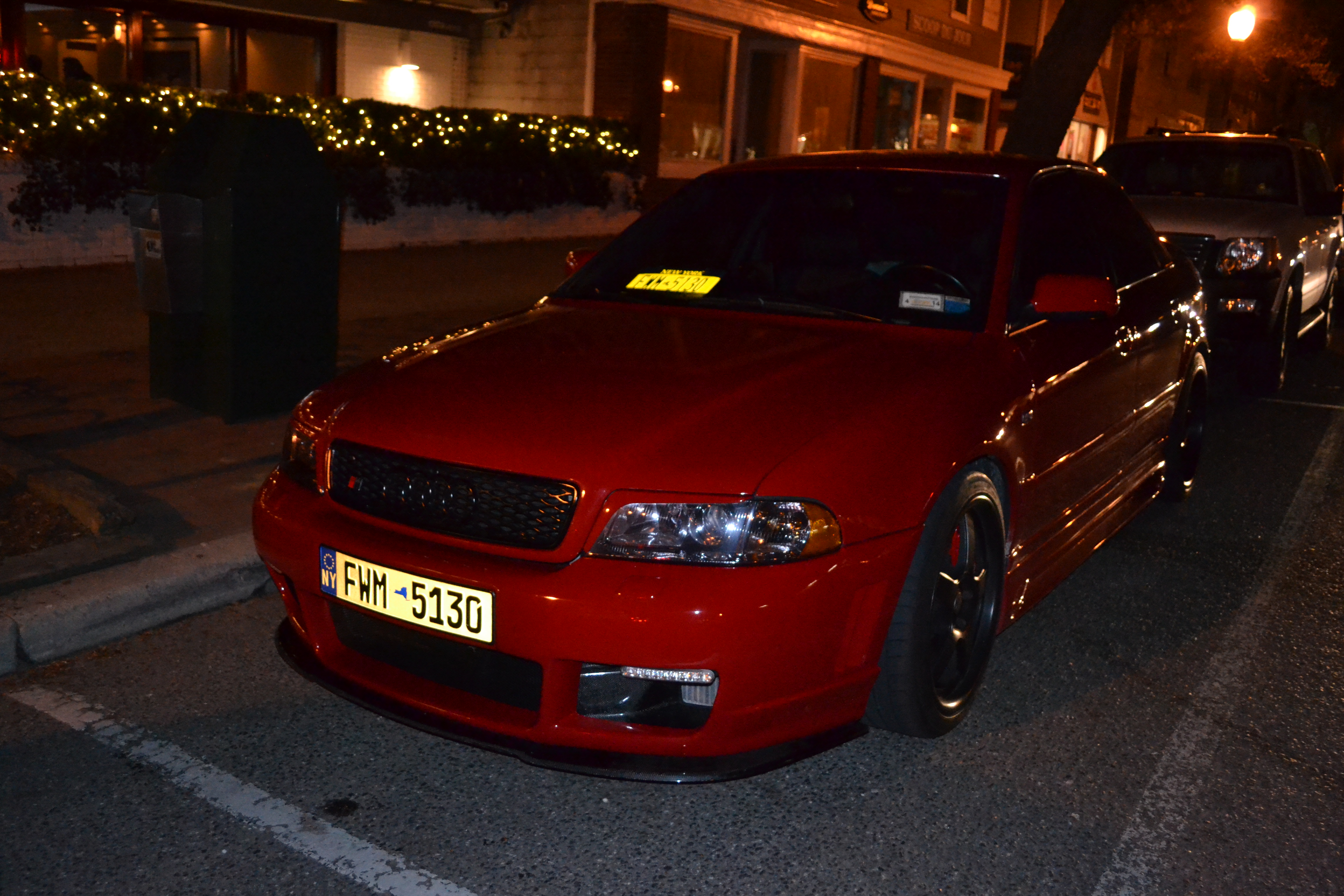
I like this car. I like Audi in general. I haven’t posted anything for a while because of AP testing and “senioritis” is kicking in pretty hard now that I just don’t care about anything. I found myself thinking about Audi as a car company for some reason. They make some average cars in general that don’t hold there own in terms of performance numbers. However, they also make some great ones. The B7 S4 really wasn’t that fast at all, this car however, the 2001 B5 S4 is a pretty remarkable little performance car, considering it’s twelve years old. This car is practically as fast as the V8 equipped B7 S4 that succeeded it. So what happened to Audi, why did the successor to this car pictured above be hardly any faster? I’ll tell you what I think.
Personally, I think Audi copies Mercedes when it comes to induction into their high-performance engines. If you look at Audi during the turn of the century, virtually every car they produced with the letter “S” or letters “RS” had some type of forced induction, usually in the form of a twin-turbo setup. Mercedes’ AMG cars also had forced induction, but their cars were supercharged. When the B5 S4 was conceived during 1997, Audi wanted to make sure that they were ahead of BMW, just like Mercedes was, in terms of horsepower (BMW was generally always behind because they historically refused to use forced induction). Audi produced a real gem with the B5 by implementing a 2.7 liter, 30-valve V6 (five valves per cylinder) with twin hybrid-driven, double overhead camshafts and variable valve timing (something GM only started to use like 4 years ago by the way). This engine was seriously advanced for it’s time. It made 265 horsepower in 1997 and 300 lb-ft of torque. That was unheard of from a 2.7 liter motor. This thing was an animal.
So why did Audi move back to a lazy, heavy V8 motor for the B7 S4 which was released in late 2005? Because at roughly the same time Mercedes was moving back to the “naturally aspirated” 6.2 liter V8 motors to put in their AMG cars, and BMW’s super-hot E46 M3 was way too fast for the B5. Ironically, Audi’s efforts were misguided, the E46 was still a bit too fast for even the V8 B7 S4. Only in 2010, did they figure out that forced induction is the way to go to achieve a balance between power and weight. With the B8 S4, my favorite Audi.
LOCATION SPOTTED: The Stephen Talkhouse (Amagansett)
Performance:
Acceleration 0 to 60: 4.8 sec
Braking 70 to 0: 156 feet (not from 60 mph)
Quarter Mile: 13.2 sec
Skidpad: 0.90 g
Slalom: 67.6 mph
The BMW M5 E39 is probably the freshest M of all time, Why? Simplicity. When this car was conceived in 1997 as a 1998 model, M was in it’s absolute prime. The battle for numbers and putting down lap times was certainly present, but it did not dominate the engineer’s mentality. Cars of the M5’s caliber were not built around the concept of “Oh, we must make the car faster and more powerful than all of it’s competition.” No, the M engineers made the car balanced. The E55 Mercedes of a similar model year may have had 470 hp when Mercedes went to “Kompressor” (supercharger) technology. BMW ran the E39 M5 for a very long time; 1997 to 2003 and not once did BMW feel the need to increase the power of their car to compete with the 2003 Audi RS6 and the aforementioned E55 AMG with 450 and 470 hp respectively. M GmbH realized and knew that their M5 was a better, more “well-rounded” car than any of its competitors. The results speak for themselves. The M5 dominated the segment, during virtually all of it’s exixstence.
The most amazing thing is that the M5 held it’s own against the Audi RS6 when it came out in 2003. The svelt brute that the RS6 is, with it’s BiTurbo V8, packing 450 hp, and putting down numbers that were comparable to the E60 M5 and E55 AMG, people thought that the Audi would finally take the leed on the M5 as it had been around for nearly 7 years. But no. No, the dynamic ability and balance of the E39 M5 make it the winner in my heart and in all the other enthusiasts’ hearts. This (I believe) is the case with all but the newest M-cars. Each M-Car’s total value is worth more than the sum of it’s parts. Performance data is really only part of the story with the E39 M5, people buy an M for the feel not the hard facts that go along with it.
The E92 BMW M3 is without a doubt the most covered, written about, and talked about luxury sport coupe. Since its introduction in 2007, the car established what a luxury sportscar should be. Since it’s conception, cars like the C63 AMG, Lexus IS F, and more recently, the Audi RS 5 have surfaced. All of these cars, even the brand new RS 5, are simply not as good as the 6 year-old M3, as an “all-rounder”. By that, I mean that though some of those cars may beat the M3 in individual categories of performance or luxury features, none of them are truly great cars, none of them are the M3. With the exception of the C63, I have driven all of the aforementioned competitors. The C63, is really just a muscle car with good suspension and brakes. The Audi RS 5, the new 2013 one, is a close second in my opinion because of its’ nice cabin materials, all-wheel drive that doesn’t suck (unlike xDrive), and its’ superb media interface; the best I’ve ever used in any car. The 2008 Lexus IS F, is just plain weird. I don’t get anything about the styling and dynamically it isn’t that much better than my 335xi (I am told the 2011+ version is a drastic improvement, I hope so for Lexus’s sake). If I was doing a true compaison test I would go more in depth about my experiences in each of those cars, but I’m not. So, let’s go into exactly why I think the M3 is so successful in it’s reign as king of the sport coupes and why I think the next M3 will do even better.
To most people, the BMW M3 has allways been just another BMW. However, when the decision at BMW M GmbH to put a V8 version of it’s crazy amazing S85 V10 motor from the E60 & E63 M5 and M6 was made, people from all over the automotive world took notice. Gone was the comparitively puny 3.2 liter inline-6 motor from the E46 and in it’s place a 4.0 liter V8 motor was implemented, with nearly 100 more horsepower and an even higher rpm redline. The V8 put BMW’s M3 on the map not only amongst Euro car enthusiasts, but it also tapped on the shoulder of higher-horsepower enthusiasts. People who like GT500 Mustangs, base-model Corvettes, and even Vipers were starting to notice BMWs’ little M car, which was no longer so little. The M3 gained about 250 lbs in curb weight during it’s transistion from the E46 body to the E92 body. The M3 became a more mature, intriguing, and compatible machine. It became more majestic. All other M3s were true sleeper cars, even to non-BMW enthusiasts. This all changed. The new M3 in it’s 2008 model year was almost $9,000 dollars more than the 2006 E46 M3, at $56,000. This put a different type of buyer into the slot of the M3 market-place. In 2007, if you wanted a fairly quick, small, european coupe, you could now get the 135i or 335i with similar horsepower to the old E46 M3 for under $40,000 and $45,000 respecitvely. If you had your eyes set on a V8 Autobahn cruiser like a CLK55 AMG Mercedes or even a Shelby GT500 Mustang, you would say “Wait, BMW sells a fast V8 now for under $60,000? Let me check that out.” Though technically the E92 M3 is selling at a lower rate of what the E46 M3 sold at, the E92 M3 is really the hero of the “M3” name. Now, everyone knows about the M3 and so many people, even if they cannot afford it, lust for it and crave it’s amazing allure of high-revving V8 power and great looks.
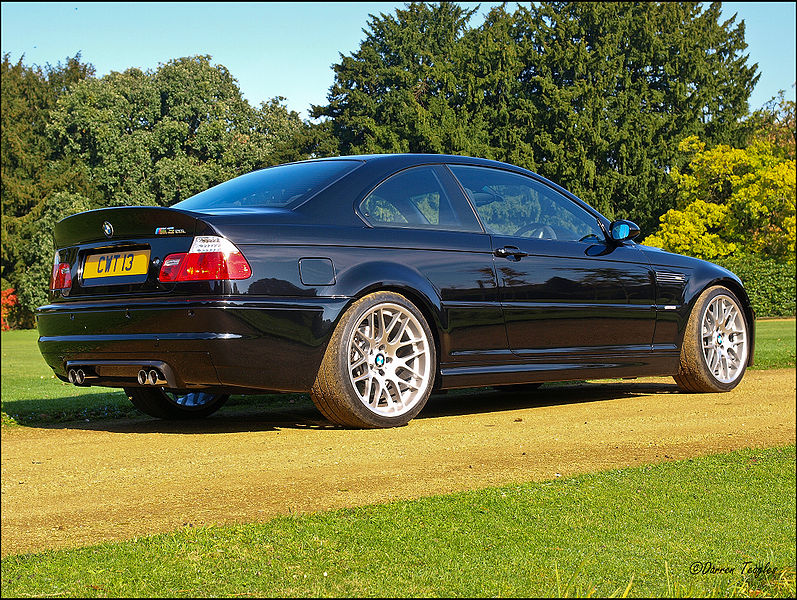
BMW M3 E46
So despite a decrease in sales over the last M3, why is the increase in price and overall caliber of the car so important, let alone beneficial to M GmbH? Because now that BMW has successfully reached out to new types of cliental, BMW can now choose to go in whatever direction they want with their new M3s going forward. 2013 will be the last production year for the current M3. Fornately with the new-found fame of the E92, the next M3 can go back to a true inline-6 engine and a much lower curb weight. That car, what ever it winds up becoming, I think will appeal to not only true M3 aficionados, but all the new customers that the E92 attracted.