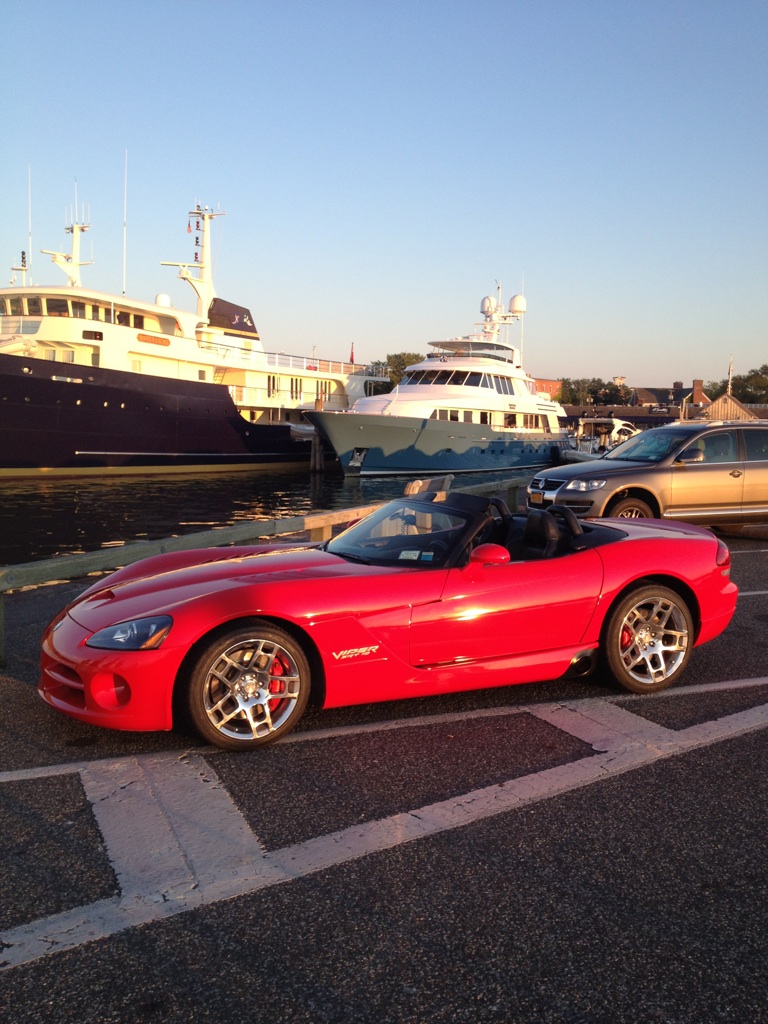
LOCATION SPOTTED: Sag Harbor Town Dock (Sag Harbor)
Performance:
Acceleration 0 to 60: 3.9 sec
Braking 100 to 0: 274 ft
Quarter Mile: 11.77 sec
Slalom: 70.4 mph
Skidpad: 1.05 g
The Viper was a revolutionary car for the Chrysler group when they introduced it for the 1992 model year in 1991. With 400 horses, the Viper served as a catalyst for the uprising modern American muscle car scene. Up until the introduction of the Viper, the Corvettes of the time were dismal at best putting out 250 or so horsepower.
Enter the 500 horsepower 8.3 liter 2005 Viper, with enough speed to match that Ferrari 360’s 0 to 60 time of 3.9 seconds, more torque than a 2013 BMW M5, and no electronic driver aids what-so-ever, watch out!
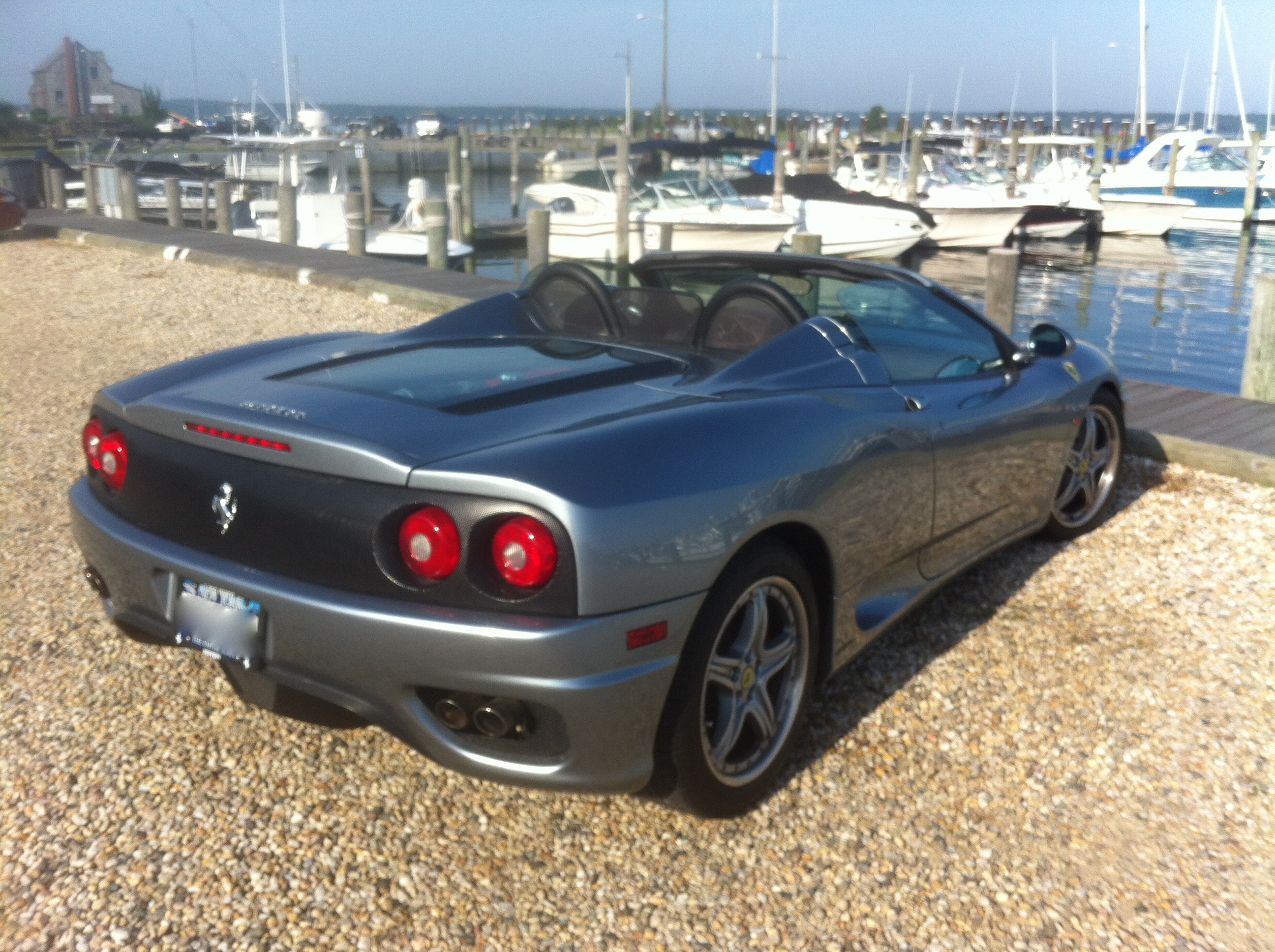
The Ferrari 360 Spider was one of the first of the company’s mid-engined cars to feature the F1 automated manual transmission. The transmission made the 360, and all other Ferrari’s mated to the transmission, much faster and easier to drive. The 360 was a very fast and capable car that should have and could have been a monumental success for Ferrari, but it wasn’t. Here’s why.
In the simplest terms, the 360 Spider works brilliantly on the track as its performance figures will confirm. However, on the road it is way too twitchy and jerky in its steering and transmission shifts. Fortunately Ferrari fixed this issue with the F430 and F430 Spider, which both work brilliantly on the road and the track. That’s why F430s hold their value and 360s don’t.
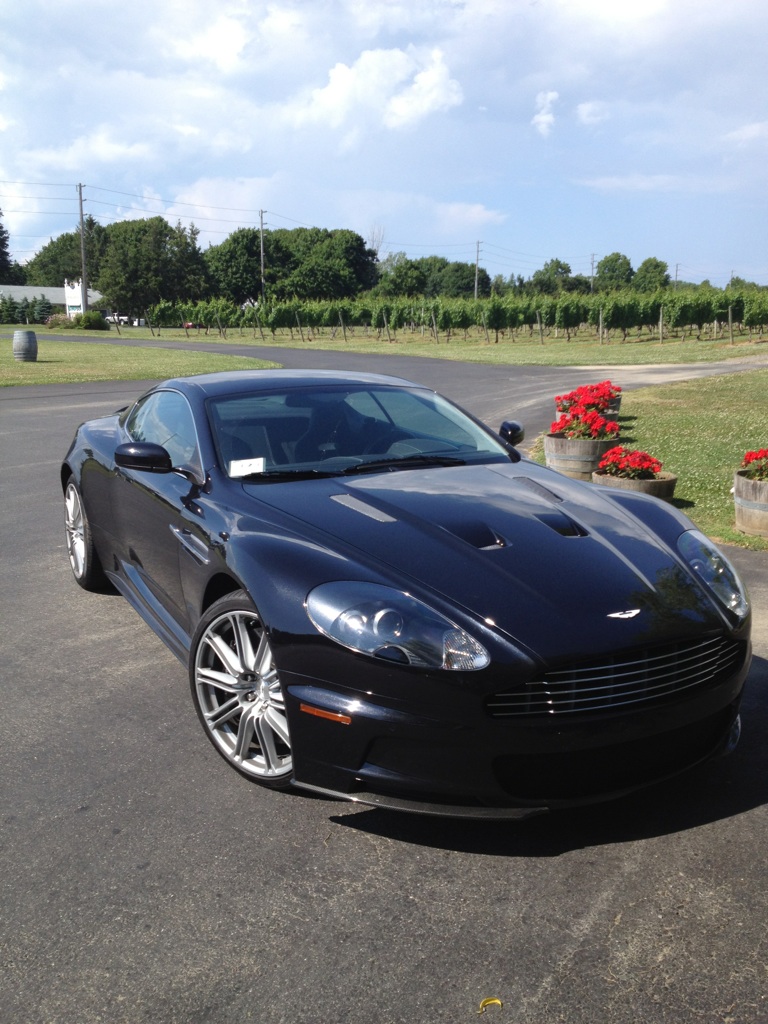
When you consider the fact that this car sells for around $275,000 new, it may be difficult to justify it’s purchase to a performance minded enthusiast. A 2011 Ford Mustang GT500 is faster than this thing in most areas for god’s sake.
Therefore, it takes a different kind of customer to buy this Beautiful British piece of design. Someone who doesn’t care about occupying the top performance bracket of the modern super-car segment, someone who can appreciate a car for more than just going fast. This person is your typical wealthy Wall Street investment banker who, when he steps inside of the sleek leather cabin of his Aston Martin DBS, feels like a ten year old kid in a candy store. Lucky bastard.
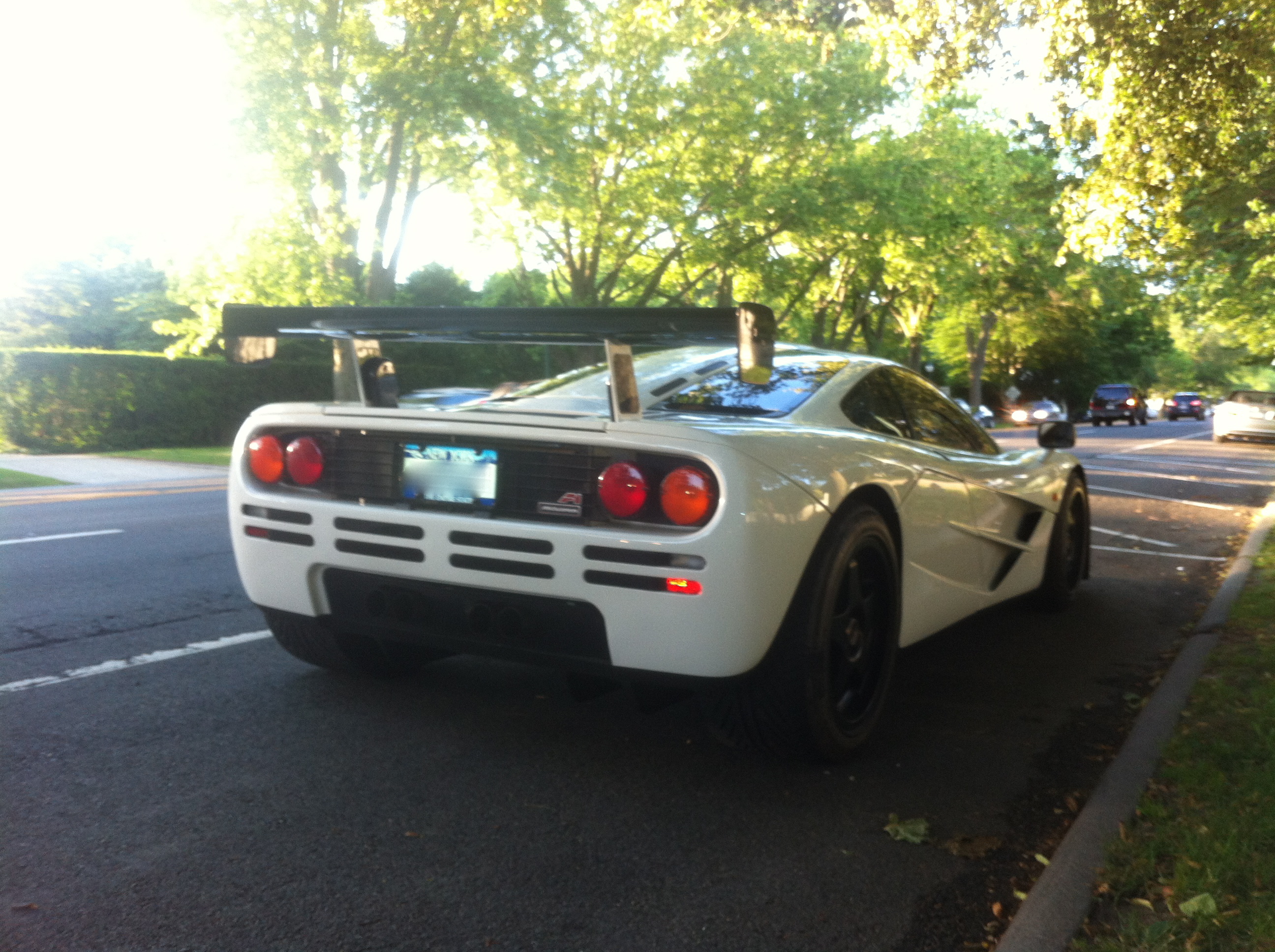
LOCATION SPOTTED: In front of Guild Hall-Main Street (East Hampton Village)
Performance:
Acceleration 0 to 60: 3.2 sec
Braking 60 to 0: 127 ft
Quarter Mile: 11.1 sec
Slalom: 64.5 mph
Skidpad: 0.86 g
Additional Specs:
Engine: 6.0 liter DOHC V12
Power: 680 hp
Torque: 520 lb-ft
Transmission: 6-speed manual
Wheelbase: 107.0 in
Curb weight: 2,341 lbs
MPG: (who cares)
MSRP: $1,307,000 est.
Damn, this is the royalty of all exotics in history. As I was driving by East Hampton in front of Guild Hall, I spotted this masterpiece.
The McLaren F1 is more than just a fast car. This is a car that has made its stable mark in automotive history. Blessed with some of the most impeccable engineering in its time, it is a watershed moment for the automotive industry.
History
It all started when a car designer by the name of Gordon Murray, the same guy who designed Formula 1 cars for both Brabham and McLaren. Its blueprint was quite simple: it is light, it is streamlined, and it incorporates a host of proprietary technologies that most super car manufacturers took literally decades to match.
It may seem odd that the braking and slalom statistics are underwhelming, but it is important to remember that this car is from the early 1990s. During that time period, even the most expensive Italian supercars were barely achieving 0 to 60 times of under the high 4-second range. When you consider the automotive market demographic that the F1 was conceived in, it is easier to fully appreciate the F1’s amazing abilities. The Mclaren may come off as a visually un-noticeable car, but in reality, this British hot-rod performer will outrun virtually any modern supercar, despite its tremendous age.
Bugatti Veyron Comparison:
The truth is that the Bugatti Veyron really doesn’t compare to the Mclaren. The Bugatti shares almost no qualities with Murray’s masterpiece. I like to view the Bugatti as a car developed from a minimalist approach, where the Bugatti was developed from an immoderate approach. The Bugatti contains ten radiators whereas most cars have one. Bugatti puts 16 cylinders with 4 turbochargers to produce 1001 horsepower in its Veyron, and they would have to, because the Veyron weighs 4410 pounds! As a result, the Veyron is very planted and drives very well, but you can feel the immense weight and it ultimately feels like a very fast Bentley GT.
When you experience the Mclaren’s lack of weight and naturally aspirated V12 power, you get a visceral feeling of speed and handling. The F1 actually feels faster than the numbers would suggest. This is a feeling that is becoming less apparent in many modern sports and supercars, which mimic the Veyron much more than the F1. The Veyrons abundance of technology may make it technically faster, but it also makes it less inspiring to drive. That is why I would choose the F1 over the Veyron all day long.